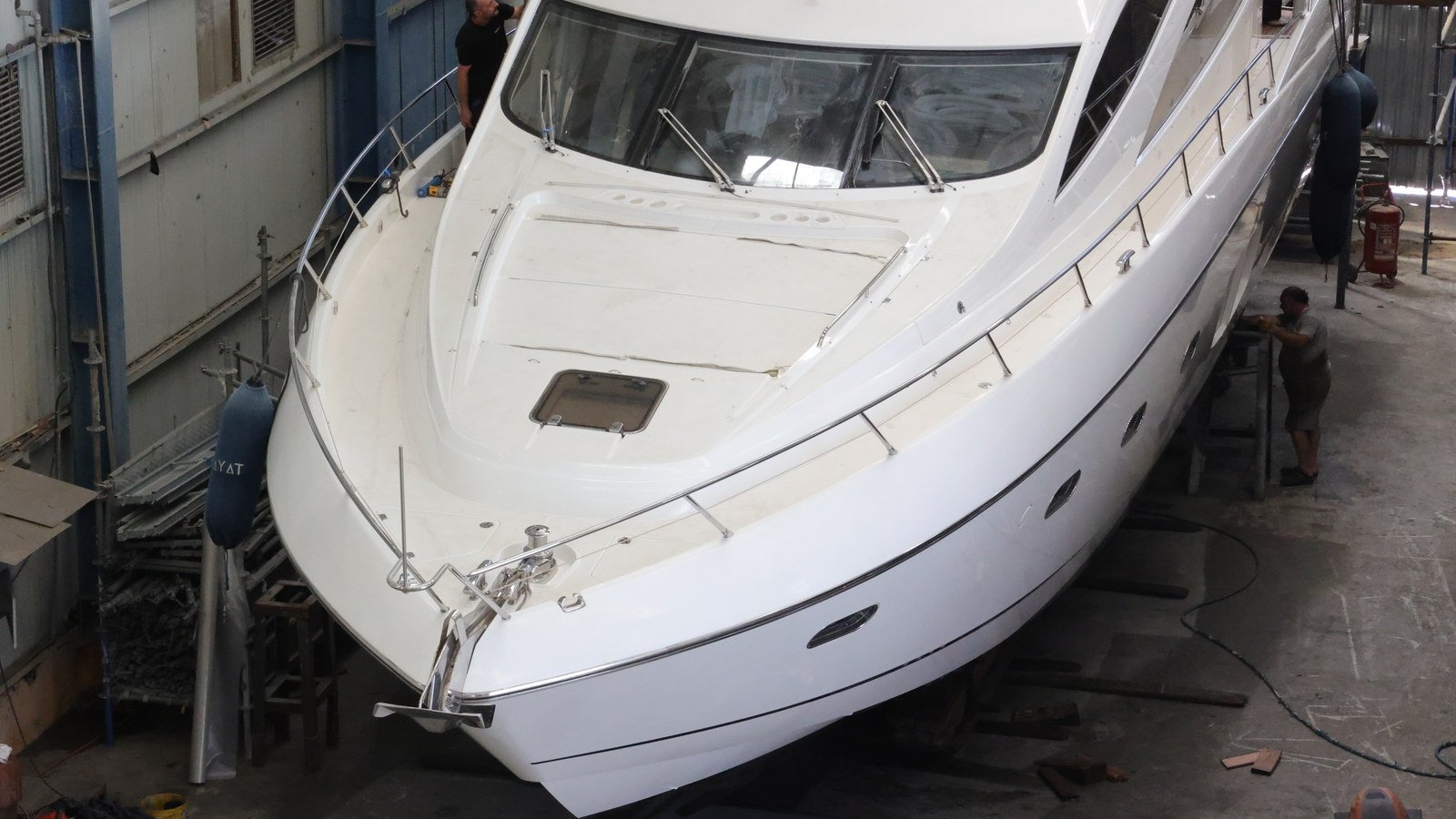
Fins, shaft seals, bearings, propellers, rudder stocks, thruster tunnels and anodes are one machine underwater. They share an access window and a set of clearances, several share the same class approval, and a decision on one moves the acceptance figures for the others: a retrofitted fin opens the same plating the shafting and the rudder hang off. A yacht underwater running gear refit is specified as one scope, and most of it is settled before she is lifted.
Where the running gear refit is decided
An in-water survey returns more than it is credited with: a diving team takes stern bush clearances and reports blade condition, and for a vessel with the in-water survey notation class accepts them in place of a docking. What no diver returns is a drop check with the rudder on its own carrier, a straightness reading on a stock, crack detection at the taper, or a verdict on a tunnel coating. Parts are ordered against those figures.
The list splits in two. A bearing set, a seal kit, a fin shaft and a class-approved insert plate are forgings and castings on the lead times that set the programme, and none can be part-numbered without the drawing: shaft diameter and taper, the bush arrangement, the seal type fitted. A stock skimmed, a liner fitted or a bush machined is the other half, done on this waterfront and offered up the same day. Which side of that line an item falls on decides whether a survey finding costs weeks or hours.
Stabilisers and the structure under them
Retrofitting stabilisation is a structural job wearing a mechanical label. A fin carries its bending moment into a foundation that does not exist yet: reinforcement of the shell, new floors or web frames in way of the actuator, and a penetration for the fin shaft with its own seal. What is approved is the reinforcement scheme rather than the joint, because the plating being cut has scantlings drawn for a hull with no fins in it.
Gyroscopic units make no penetration for a fin shaft, which is the attraction, though a seawater-cooled unit still wants its own inlet, outlet and strainer. They exchange a hull problem for a weight problem: precession torque is reacted through the unit's own seat, and the mass sits wherever it can be got in and cooled. Both land in the stability book.
Zero-speed and underway damping are two specifications, and fin area, actuator sizing and hydraulic demand follow whichever is asked for: fins sized to damp her underway will not hold her at anchor. What that demand does to the power pack that also feeds the passerelle and the cranes is settled in the same week.
The seal and bearing package
Seals and bearings are chosen together. A water-lubricated cutless bearing runs a wider clearance and forgives a leak, because what it leaks is water. What it does not forgive is silt: abrasive in the lubricating water sets its wear rate, which is why turbid water shortens bearing life. An oil-lubricated white metal bearing keeps grit out and runs tighter, and depends on the seal holding its oil in and the sea out, a lip set or a mechanical face seal — and which she has decides whether the shaft comes out to renew it.
Wear-down against shaft diameter schedules renewal, read as a trend: plotted against the last docking it becomes a rate, and a rate can be ordered a year ahead. Whether the wear is even matters as much, because a bearing worn to one side is reporting on alignment, which a new bearing does not answer.
Rudder bearings are two measurements, often confused. The drop check measures wear in the carrier bearing, the rudder jacked and the vertical movement read against its limit; neck and pintle wear is radial, taken with feelers or as a jumping test. The stock is checked for straightness and crack-detected at the taper where the rule requires it.
Propellers as a matched set
A propeller is a matched item, and the set is matched to itself. Pitch is measured at defined radii against the drawing and the tolerance class named, ISO 484-2 for wheels of 0.80 to 2.50 m diameter and ISO 484-1 above that, edge thickness against the repair limits, and the wheel balanced to its grade under ISO 21940-11. Repair one blade properly and its pitch and its mass have both changed, so a repaired wheel goes back through pitch check and balance as a set.
Diameter is settled first, because tip clearance follows from it, and that gap governs how much of the blade-rate pressure pulse arrives inboard as noise. A wheel dressed back in repair has lost diameter and thrust with it; one built up past the drawing has closed the gap.
Thrust lost in the tunnel
A tunnel thruster loses more of its thrust to the tunnel than to its motor. Grids cost thrust, and cost more when the bars are the wrong section, at the wrong angle to the flow, or bent. Tunnel ends faired flat, or coated until the radius at the hull is lost, cost more again, and inside, the coating takes cavitation damage nobody sees between dockings.
The propeller, the hub and the seal are reachable only now; the coupling and motor are inboard and can be worked afloat. But motor-to-unit alignment is set here, on blocks and unloaded, and a tunnel is stiff local structure with little tolerance at the coupling, so whatever the hull takes up between blocks and water is taken up there.
Cathodic protection as a circuit
Anodes are the visible end of an electrical system, and the two things that set the arrangement are not visible. The first is stray current: in a shared repair basin, a faulty shore supply, a welding return through the water or a neighbouring hull on the same quay pushes current down the easiest path, and shafts, propellers and stocks are bare metal with a bearing between them and the bonding. A yard period is the only time it can be measured against a fixed reference cell.
The second is the coating. Bare steel demands current and a sound scheme a fraction of it, so a hull going back in under a full underwater coating scheme, carrying the anodes it had when the paint was tired, is over-protected, and over-protection blisters coatings and embrittles some alloys. The calculation is redone against the scheme going on.
Acceptance on the trial
Seals and hydraulic leakage are read at the dock trial, the shaft turning and the fins cycled against their stops; the sea trial adds load, revolutions and a beam sea. The figures they are read against belong in the specification, written before she is lifted: leak rate at temperature and revolutions, a vibration limit at a stated reference position, a clean progression through the range with no resonant band, thruster current draw against rating with a timed rate of turn each way, and, for zero-speed, roll reduction held at anchor. How they are taken and witnessed belongs to the trial programme.
Written at the yard in Tuzla. What is described here is this yard's own practice; the limits that govern any particular shaft, fin or wheel are the ones in her class file and her build specification.
What can be machined here, and what must be ordered
Send us her propeller drawings with any repair history on the wheels, the tunnel and grid arrangement, the bonding diagram, and, for a retrofit, the midship section and the current stability book. We will tell you which of it can be machined here and offered up, and which items are long-lead enough to be worth ordering against the trend rather than waiting for the survey to find them. Write to info@revivarefit.com or call +90 (850) 226 28 72.
SEND US HER DRAWINGS