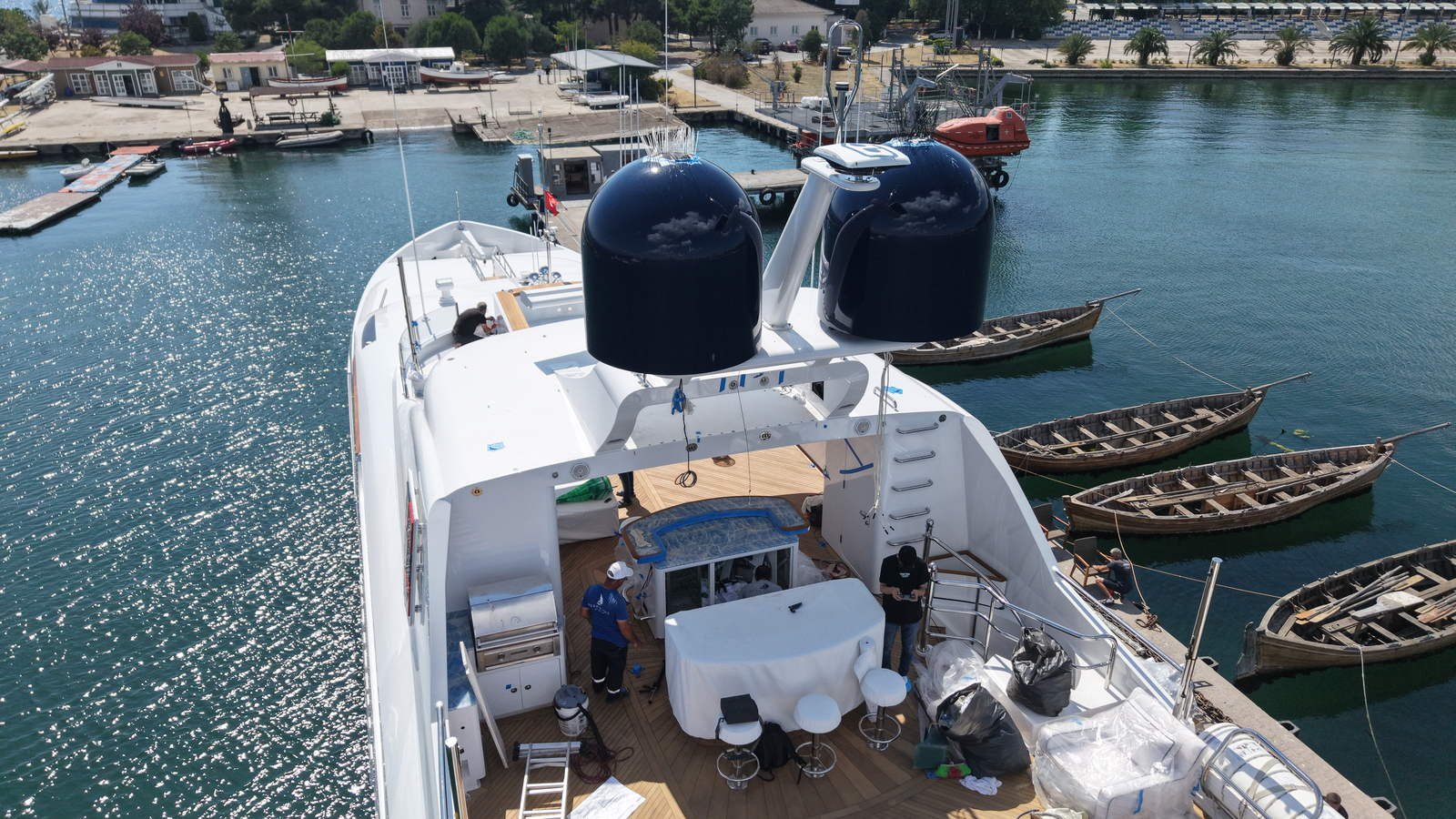
A refit is nearly always described from the yard's side: scope, programme, workshops, dates. The people who arrive with the boat live through it from the other side — three, six or nine months in an industrial district on Istanbul's Asian side, aboard a vessel that for part of that time is a building site with a hull around it. Living aboard during a yacht refit in Tuzla is therefore a scheduling question before it is a comfort one.
A refit goes wrong less often at the weld than at the decision behind it, taken by somebody working from a drawing rather than from the boat. On site through the yard period, the crew are usually the only people carrying the second version.
The end of living aboard
Habitability follows the services, not the calendar. The moment a yacht comes out of the water her sea chests are dry, and everything depending on raw water stops with them: chilled-water air conditioning, the watermaker, generator cooling, overboard discharge. Sanitation becomes a holding tank pumped ashore on somebody else's schedule, or the shoreside block.
After that the interruptions are scheduled rather than accidental, which is the useful part. Four windows reliably put everybody ashore: the main switchboard down, with the hotel load on a trailing shore cable; tanks opened, gas-freed and entered for cleaning or coating; the hull inside blast containment, run at negative pressure so grit and dust stay in it rather than in the basin; and that enclosure re-rigged as a spray tent on filtered make-up air and filtered extraction, with solvent vapour in it through every application.
Each window has a date at both ends, which is what decides the kind of let taken ashore: by the month rather than by the night. The bed itself is a contracted budget line rather than a courtesy, and the passage in, the agent and the entry regime that surround it are dealt with in planning a yard period in Turkey.
What the drawings do not record
The crew's part in a refit is not spectator and not free labour; it is continuity of knowledge. Drawings record what was built. The crew know what the boat became after ten years of other people's yard visits: which valve was relabelled, which pump has always run warm, which hatch takes water on port tack and has been living on a bead of sealant. That knowledge is only worth anything if it is captured before the strip-out, because afterwards the evidence is in a skip.
The crew will also operate whatever is installed. A decision taken without the engineer produces an installation that is technically correct and practically unusable, and the yard runs no watch, so it will not be the yard that discovers it. Where a superintendent is engaged as well, the reporting lines belong on paper on day one, because two instruction channels let scope grow without anybody owning the decision.
The captain's hold points
A captain's difficulty in the yard is standing rather than eyesight. The yard's programme decides when a compartment is closed, and a captain with nothing written into the contract can ask for one to be held open only as a favour. A hold point turns that into an obligation: a named stage the yard may not pass until the captain or the chief engineer has seen it and signed.
- Stages named one at a time, not as a class: this tank, this pressure test, this length of run.
- A working day's notice, so signing does not mean signing for something closed the previous afternoon.
- A named signatory each side, with a stand-in, since neither person is aboard for nine months without leave.
- What happens when nobody comes: the stage proceeds, or it waits, and the contract says which.
A captain with those has a watching brief; without them, a tour.

The line the permit draws
The yard's own people work under its ship repairer's liability cover and hot work permits; crew working alongside them sit outside both, and that line is drawn by the cover rather than by goodwill.
Inside it there is plenty crew can usefully do, most of it work the yard cannot do for them: inventory and stores, tender servicing, and chasing the drawings, manuals and certificates the ship's file will otherwise be missing at redelivery. Deck teams varnishing on their own account is sensible provided it sits inside the programme rather than beside it.
Three visits worth the flight
A refit has visually rewarding stages and punishing ones, and the punishing ones occupy the middle. Three visits repay the flight: early, when she is stripped and every decision is still cheap; at the first dry fit of joinery, when a space can be stood in rather than imagined; and at primer, when the hull reads as one surface and a light held low, sighted from forward, finds a wave that the eye misses square on. The reflection that confirms the shape comes later, with the gloss.
The visit to avoid is the one taken mid-fairing. Fairing is iterative — filler, guide coat, long-board, fill again — so at any hour the hull is patchwork grey and pink under dust and a tent. That surface is not the surface she will have, and an owner standing under the tent forms a strong opinion about a finish that does not yet exist. Whichever stage is chosen, three decisions closed on the fabric, the finish and the layout beat a set of photographs, so the decision list goes out ahead of the visit.
Certificates, rotation and the handover
Crew certification expires on its own calendar and takes no notice of the refit, and a yard period is the one predictable window in the year for revalidations, medicals and refreshers. Rotation deserves the same planning: a roster built with an overlap lets the departing engineer brief the arriving one face to face, so the boat never loses the person who was aboard when the compartment was open.
The last thing a yard period owes the crew is the handover. New systems arrive with commissioning engineers who then fly home, and whatever they did not pass on goes with them. The question at redelivery is not whether a system works but who can work it on the first passage, which is why the crew belong at setting-to-work rather than on the receiving end of a manual afterwards. Ask for a recorded familiarisation session per system while those engineers are still on site; the rest of the pack is handed over at redelivery as a matter of course.
Keeping the joiner, the welder, the painter and the electrician on one payroll and one programme, as Reviva does, is what makes that handover a single conversation instead of five. One programme also means one progress meeting a week, with the trades that would each have sent a representative already in the room.
Written at the yard in Tuzla, where the windows in which a boat cannot be slept aboard are marked in the programme before the contract is signed.
Which weeks she cannot be slept aboard
If you are scoping a yard period, we will walk the programme with your captain and mark the windows in which she cannot be lived aboard. Send the dates you are working to, and how many crew are staying with her, and it comes back marked up before anything is signed. Write to info@revivarefit.com or call +90 (850) 226 28 72.
SEND US YOUR DATES